A Complete Guide to Bulk Cat Litter Purchasing for Pet Brands
Nov. 09, 2026
Share:
When a pet brand starts sourcing bulk cat litter, the challenge is rarely finding a low quoted price. The real work is matching a litter formula to customer expectations, packaging it without moisture damage, meeting the right minimum order quantity (MOQ), and protecting margin after freight, warehousing, and private-label costs. This bulk cat litter purchasing guide is designed for pet brands, distributors, and retailers evaluating wholesale cat litter for pet brands or private label bulk cat litter. It explains clumping cat litter, bentonite cat litter, silica gel cat litter, sodium bentonite, bulk density, and moisture absorption so purchasing decisions can be based on measurable specifications rather than adjectives.
A quotation of $X per metric ton does not reveal the final cost of selling litter under your brand. Two products with the same mineral base can differ in granule size, dust emission, clump integrity, odor-control chemistry, bag weight tolerance, and container utilization. Those differences affect customer complaints, return rates, shelf life, and the number of usable trays filled from each bag.
For example, a 10 kg bag with 2% net-weight variance can contain 200 grams less litter than the stated quantity. Across 20,000 bags, that difference represents 4,000 kg of product. Similarly, a product with 1.5% dust by mass may create a noticeably different user experience from one tested at 0.3%, even when both are marketed as low-dust.
Pet brands should therefore evaluate bulk cat litter as a complete supply system:
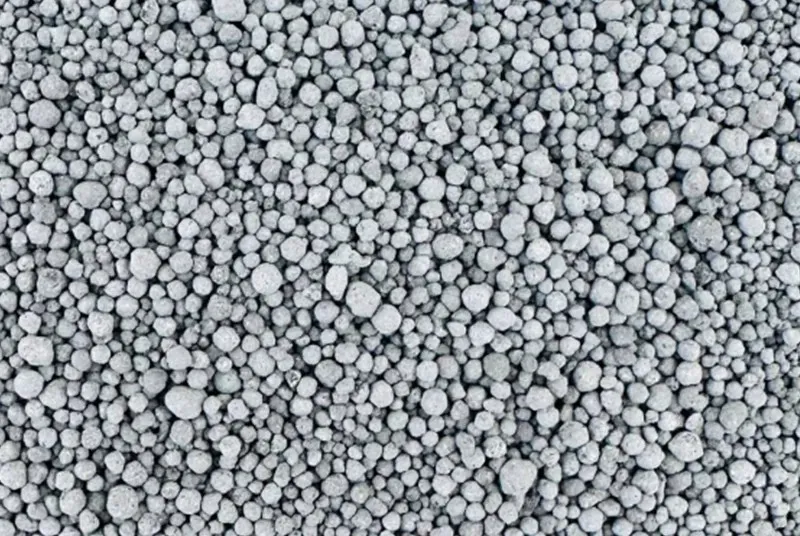
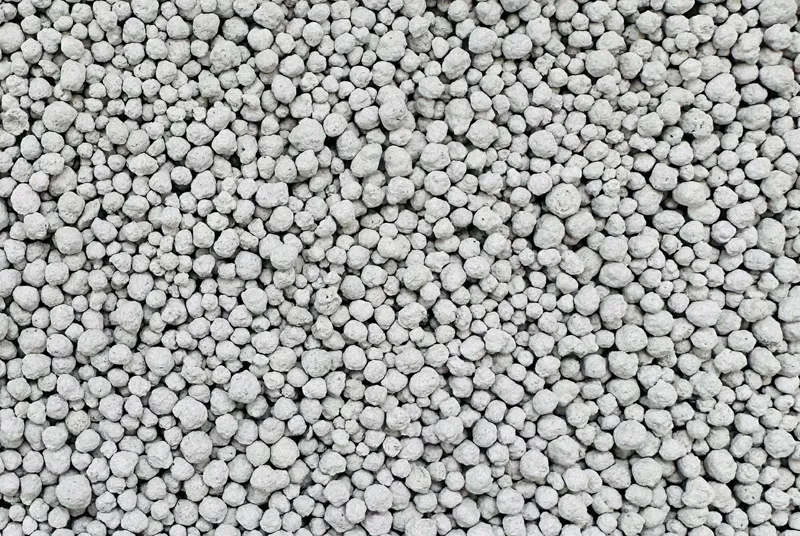
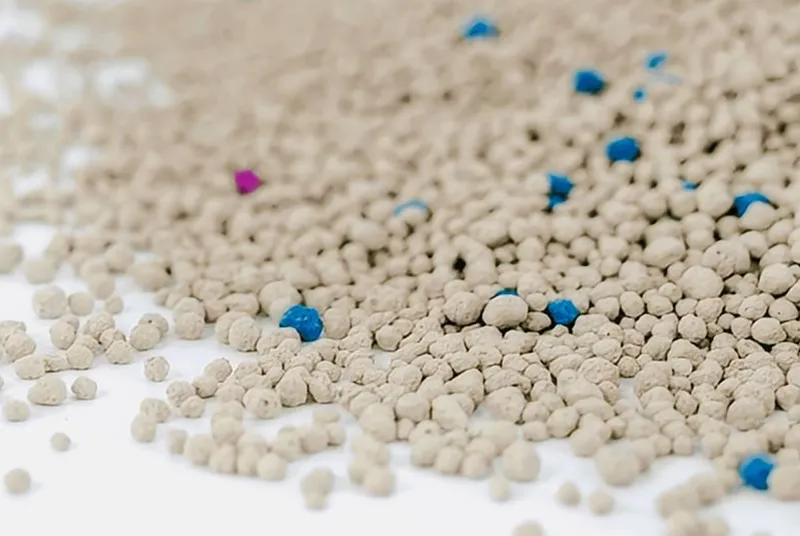
Bentonite cat litter is commonly based on sodium bentonite, a swelling clay containing montmorillonite. When exposed to liquid, the clay absorbs water and expands, allowing particles to bind into a removable clump. The commercial value of the formula depends on more than absorption capacity. Clump formation must be fast enough to reduce liquid migration and strong enough to survive scooping.
Useful specifications to request from a supplier include:
A practical product target might be a clump that forms within 10–30 seconds and retains at least 90% of its mass during a standardized sieve test. These are purchasing targets rather than universal industry requirements; the testing method must remain identical between samples and production batches.
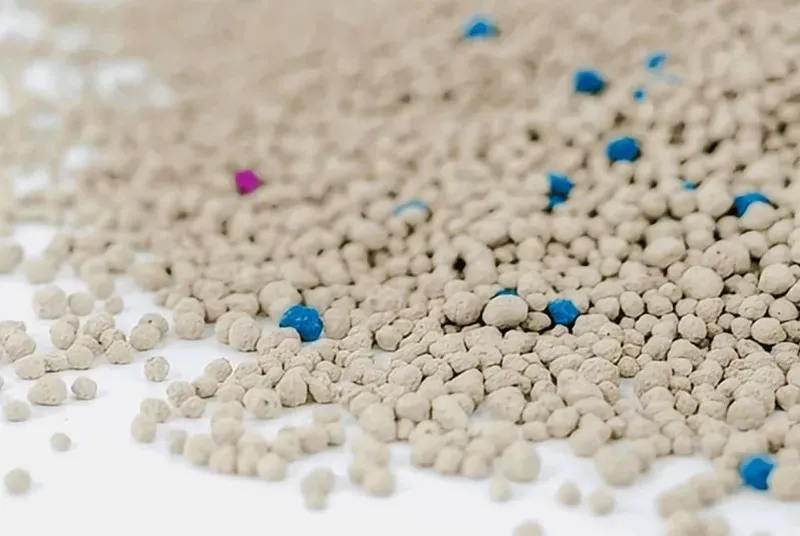
Silica gel cat litter uses porous amorphous silicon dioxide. Its pores capture liquid and volatile compounds, while the granules remain largely intact rather than forming a clay clump. The key purchasing variables are pore structure, crystal or bead size, color consistency, dust level, and the rate at which the material becomes saturated.
Silica products are often suitable for lightweight positioning because a smaller volume can provide high liquid uptake. However, a brand should test how much usable capacity remains after several days in a real litter tray. A laboratory absorption number alone does not account for uneven distribution, fecal moisture, ventilation, or user scooping habits.
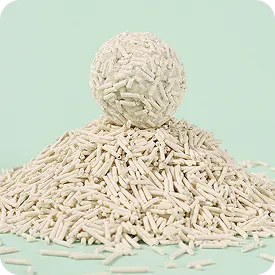
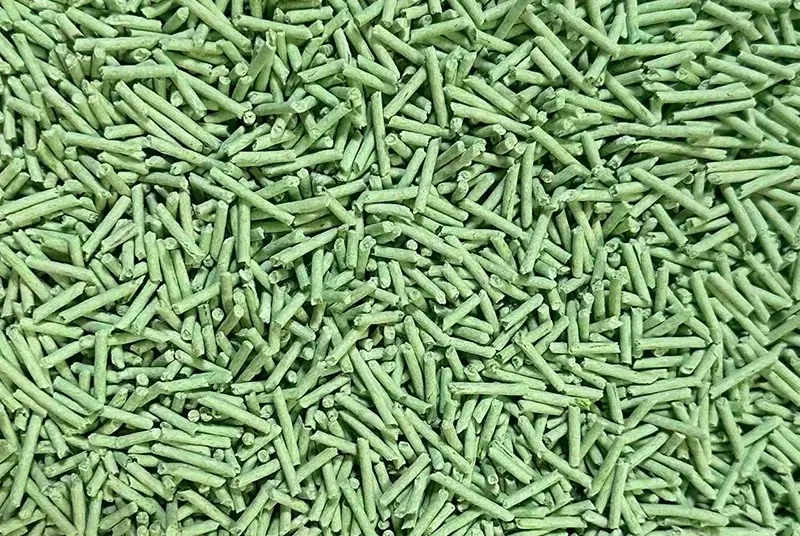
Plant-based litter may use soybean fiber, pea fiber, corn starch, wood fiber, or combinations of these materials. Starch can support clumping through hydration and binding, while plant fibers influence biodegradability, pellet strength, and odor retention. Pine-based formulas may rely on wood fiber structure and natural aromatic compounds, but resin content and moisture levels need monitoring.
For plant-based products, ask for moisture content, pellet durability, swelling ratio, biodegradation claims, and microbial-control procedures. A moisture increase of only a few percentage points during storage can soften pellets, increase fines, and reduce package stability. If the product is positioned as flushable or compostable, obtain country-specific legal and wastewater guidance before printing that claim.
Begin with the problems your customers actually report. “Too dusty” should become a dust-emission ceiling. “Does not clump” should become a wet-clump retention target. “Smells after one day” should become an odor-control test involving a defined amount of litter, liquid, exposure time, and evaluation method.
A simple specification sheet may include:
| Specification | Example purchasing target | Why it matters |
|---|---|---|
| Particle size | 0.5–2.5 mm, with agreed tolerance | Influences tracking, clump shape, and user perception |
| Dust emission | Not more than 0.5% under a defined test | Supports cleaner pouring and lower visible airborne fines |
| Moisture | Set by material type and packaging system | Controls caking, mold risk, and pellet durability |
| Clump retention | At least 90% after standardized handling | Reduces residue left in the tray |
| Net weight | Declared weight with a documented tolerance | Protects compliance and margin |
| Odor performance | Defined score or instrumental method after 24–72 hours | Creates a repeatable claim instead of subjective wording |
Do not copy a competitor’s specification without confirming the test method. “Absorbs 300%” can refer to a different liquid, sample mass, exposure period, or calculation formula than “absorbs 300 grams per 100 grams.”
Choose the formula according to the intended channel. A premium subscription product may prioritize low dust, fine granules, and fragrance-free odor control. A mass retailer may require a lower landed cost, stronger packaging, and a 10–15 kg family-size bag. A multi-cat household product may need higher saturation capacity and more robust clumps.
Request at least three samples from each candidate supplier:
Evaluate each sample in identical litter trays. Record the amount used, liquid volume, clump-formation time, clump mass, visible dust during pouring, tracking after 24 hours, and odor score. A basic spreadsheet is sufficient, but each tester should use the same scoring scale.
The purchasing price is only one component of total cost of ownership. Use this calculation:
Landed cost per sellable kilogram = product price + packaging + inland transport + export charges + ocean or air freight + insurance + import duty + destination handling + warehousing + quality losses, divided by sellable kilograms.
Consider a simplified example. A shipment contains 20,000 kg at $0.18 per kilogram, packaging costs $0.06 per kilogram, freight and import-related charges equal $0.09 per kilogram, and quality or handling loss is 1.5%. The pre-loss cost is $0.33 per kilogram. After accounting for the loss, the effective cost is approximately $0.335 per sellable kilogram. A supplier offering $0.17 per kilogram may become more expensive if its dust, leakage, or moisture-related loss reaches 5%.
For a serious quotation comparison, request:
MOQ should be evaluated against your sales forecast, not accepted as an isolated factory rule. If monthly demand is 8,000 bags and the supplier’s MOQ is 30,000 bags, calculate how many months of inventory the order creates after allowing for safety stock and seasonal demand.
Ask for a capacity plan showing monthly output, packaging-line capacity, and peak-season constraints. Also confirm whether the supplier uses one mineral source or several. A change in mine, clay blend, additive ratio, or drying temperature can alter absorption and granule strength even when the printed product name remains unchanged.
Packaging must protect the product from humidity, abrasion, puncture, and compression. Clay and plant-based litter can absorb moisture during ocean transport, especially when containers move between warm and cool climates. A multi-layer bag may use woven polypropylene for strength, polyethylene for moisture resistance, and an outer printed layer for branding.
Test the finished package rather than reviewing only the material certificate. Recommended checks include:
For a 10 kg bag, a 10-bag sample is a starting point for an internal check, but larger lots should follow a documented acceptance-sampling plan. Record both average weight and the lowest individual weight; an acceptable average cannot compensate for an underweight package.
Before printing, confirm the product name, ingredient or material description, net quantity, manufacturer or importer information, country of origin, use instructions, disposal guidance, batch code, and warnings required in the destination market. Claims such as “100% dust-free,” “flushable,” “biodegradable,” or “chemical-free” may create compliance problems if they cannot be substantiated.
Use a color proof and a signed artwork approval process. Confirm that the barcode has sufficient quiet zones, the font remains legible at the final bag size, and the lot code can be printed without covering mandatory information. One artwork error can affect an entire production run, so final approval should be separated from commercial approval.
Pre-shipment inspection should compare production goods with the approved golden sample. A useful inspection checklist covers appearance, odor, particle size, dust, moisture, clump behavior, packaging, carton or pallet condition, and quantity.
For a batch of 20,000 bags, define the inspection level before production. Do not allow the supplier to select only visually perfect bags. Samples should be drawn from different pallets, production times, and container positions. Retain sealed reference samples from the approved batch for future complaint analysis.
A certificate of analysis is useful only when it identifies the batch, test method, result, specification, and testing date. A document that says “high absorption” without a numerical method cannot support a meaningful acceptance decision.
Place a fixed mass of litter in a clean tray, add a measured volume of synthetic urine or water at a defined rate, and record the time until the liquid is no longer visible. After a fixed resting period, remove the clump and weigh it. Then pass it through a defined sieve or apply a drop test to measure retained mass.
Repeat the test at least three times per sample. Report the mean and range rather than a single best result. If one sample forms a 120-gram clump and another forms a 90-gram clump under identical conditions, the difference may indicate uneven granule distribution or inconsistent sodium bentonite content.
Dust is influenced by transport, bag filling, and user pouring technique. Weigh a sample, agitate it using a defined number of rotations or shakes, collect the fines below a selected particle size, and calculate the percentage by mass. The method must be written into the purchasing specification.
Visual inspection remains useful. Pour the same 2 kg quantity from the same height under consistent lighting and photograph the plume. This does not replace laboratory measurement, but it helps connect numerical results with the customer experience.
Odor control can involve physical adsorption, moisture reduction, pH management, fragrance, or additives such as activated carbon and zeolite. Testing should distinguish masking from actual odor reduction. Use identical containers, litter mass, liquid volume, exposure time, temperature, and ventilation.
A panel can score odor intensity on a 0–5 scale, while instrumental methods may measure selected volatile compounds. The report should identify whether the formula is fragrance-free, lightly scented, or strongly scented, since some consumers interpret added fragrance as an odor problem rather than a solution.
Consider a fictional pet brand planning to sell 10,000 bags per month in a 10 kg format. It is choosing between a standard clay formula at $0.20 per kilogram and a low-dust formula at $0.24 per kilogram. The premium option costs $0.04 more per kilogram, or $0.40 more per bag.
The brand conducts a 60-day pilot with 1,000 bags of each formula. The standard formula generates a 3.8% complaint rate, while the low-dust formula generates 1.9%. If each complaint costs $6 in replacement product, customer service, and freight, the estimated complaint cost is $2,280 for the standard batch and $1,140 for the low-dust batch. The low-dust option costs $400 more in product cost for 1,000 bags but saves approximately $1,140 in complaint handling before considering repeat purchases.
This is not proof that every low-dust formula will produce the same result. It demonstrates the correct decision process: measure the additional cost, measure the operational benefit, and test the result with the target customer group. A premium formula should earn its position through lower total cost, stronger retention, better reviews, or a higher selling price.
Keep an approved golden sample in sealed, labeled storage. Compare every production batch against it for particle size, color, scent, moisture, dust, and clump behavior. Define which differences require rework, price adjustment, or rejection.
A batch-release system is especially important when manufacturing and packaging occur at different facilities. The product may pass the factory test but change during transport to the packaging site. Retest after filling if the product has been stored for more than a few weeks.
One supplier may offer the lowest cost, but a second qualified source can protect the brand from port delays, mineral shortages, equipment failure, or sudden capacity restrictions. The backup supplier should be approved before an emergency occurs.
To avoid a sudden user-experience change, define an equivalence range. For example, the alternate formula may need to remain within an agreed range for particle size, moisture, dust emission, absorption, and clump retention. Do not switch formulas solely because the product has the same color or marketing name.
Packaging dimensions affect the number of sellable kilograms per container. A bag that uses 3% more empty space can reduce container utilization enough to erase a product-price saving. Compare bags by pallet footprint, stack height, compression strength, and number of bags per container.
Calculate freight per bag, not only freight per container. For example, if two packaging formats have identical freight of $2,400 per container but hold 22,000 bags and 19,000 bags respectively, freight allocation is approximately $0.109 per bag versus $0.126 per bag. The second format costs about $0.017 more per bag before any product difference.
Set a first-in, first-out or first-expired, first-out system according to the product’s stability profile. Store bags on pallets, away from walls and direct floor contact, with warehouse humidity and temperature logged. Inspect for swollen bags, hardened granules, odor changes, and seal failure.
Safety stock should reflect demand variability and replenishment time. A simple model is:
Safety stock = average daily demand × additional protection days.
If average demand is 350 bags per day and the brand wants 12 protection days, safety stock is 4,200 bags. A more advanced calculation can use demand standard deviation and supplier lead-time variability, but even the basic model is better than ordering only when inventory reaches zero.
A reliable bulk cat litter program begins with a written product brief, not a supplier catalog. Define the intended customer, litter type, particle-size range, moisture limit, dust method, clump target, packaging structure, MOQ, and landed-cost ceiling. Then test commercial samples under repeatable conditions, inspect production goods before shipment, and retain reference samples for future comparison.
For brands that need a coordinated solution, Petcare can be contacted to discuss product selection, bulk supply, private-label packaging, quality-control requirements, and shipment planning. Whether the target is bulk cat litter purchasing for retail, wholesale cat litter for pet brands, or private label bulk cat litter, the strongest purchasing decision connects measurable performance with total cost of ownership. Evaluate sodium bentonite, moisture absorption, bulk density, clumping cat litter, bentonite cat litter, and silica gel cat litter using the same test logic, and the final product will be easier to position, easier to replenish, and more consistent for the households that use it.
Latest Blog / Insights
Hot Products


Let’s Get Started on Your Cat Litter Journey.